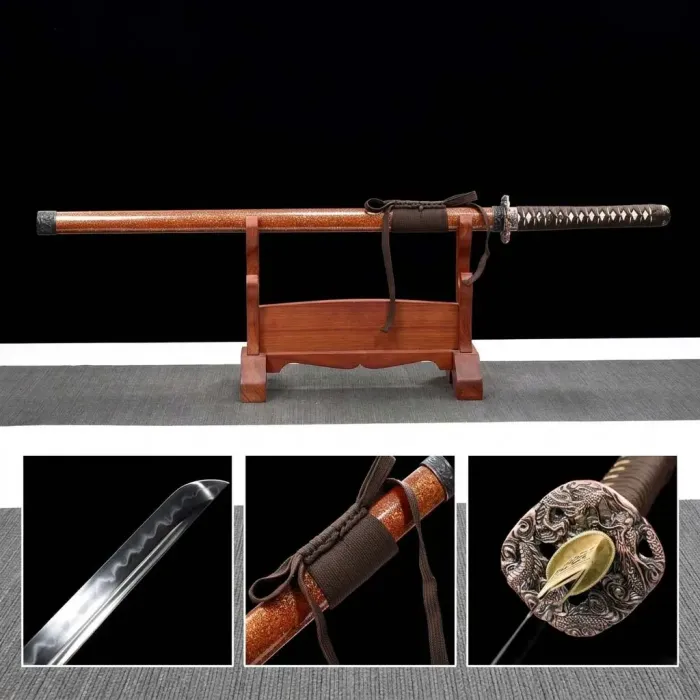
The classic ancient blade functions as a stunning showcase of talent, but suppose you long for to reveal your separate flair? Personalizing your weapon is a profound journey, allowing you to assemble a truly exceptional piece. From the grasp wrapping and collar to the shield design and marking, each feature offers a chance for specialized modification. This study delves into the territory of katana modifications, providing guidance for both learners and experienced enthusiasts pursuing to establish their mark on the traditional art of the samurai.
Freshman's True Handiwork
For learners determined to embark on the rewarding journey of katana handling skills , 1060 steel katanas bring an excellent entry point. This certain grade of elemental-based steel finds a suitable blend between price and efficiency . While inferior to hard as leading steels, 1060 accommodates a reasonable level of edge development , making it ideal for newcomers to acquire the foundations of blade preservation and respect the beauty of authentic Japanese weaponry. It’s a wonderful choice for developing experience without the budgetary burden of more specialized steels.
T-10 Steel Blades : Achieving Effectiveness and Cost
For hobbyists seeking an authentic blade experience without busting the finances , T10 compound katanas represent a favorable option. These blades offer a reasonable improvement in resilience compared to cheaper alternatives, exhibiting decent edge retention and sufficient flexibility for rudimentary slashing techniques. While not rivaling the eminent characteristics of advanced steels like T100 or folded alloy , T10 provides a impressive blend of functionality and profitability, making them a appreciated choice for initiates and those on a fixed budget .
Beyond the Sharpness : Adapting Your Cutting Weapon's Hardware and Hold
Considering the buffed steel is undeniably the focal point of a katana, truly boosting its charm lies in the meticulous customization of its elements and hilt . This practice allows owners to reveal their personal approach . Reflect on the vast possibilities: menuki - decorative ornaments that enhance visual beauty ; the hamon sleeves – often exquisitely crafted ; the tsuka essence itself, wrapped in genuine ito binding ; and the fusa end piece , which can be designed from various components like valuables or ivory .
- Prefer concepts that echo with you.
- Test with distinctive elements .
- Concentrate on excellence for a stable statement .
The Allure of the Katana: History, Craftsmanship, and Steel
This traditional armament bears a exclusive allure, steeped in phases of the nation's history and culture . More than merely a apparatus of battle , it's a token of the champion ethos – a fusion of skill and restraint . Its maturation spanned score generations, with early swords evolving into the sleek curvature and sharp edge we understand today. The artistry involved is truly exceptional , requiring spans of coaching to master . The process involves a involved folding of smelted iron , creating layers that fortify the instrument’s flexibility and slicing ability. Diverse schools of crafting appeared , each with their separate secrets and techniques for achieving the ultimate poise and acuteness - a truly strenuous pursuit.
- First Katana models
- The significance of the oriental sword in knight culture
- Time-honored fabricating procedures
Determining the Right Steel for Your Armament Project: 1060 vs. T10
Identifying the favorable steel is essentially important for any cutlery project, and the conclusion between 1060 and T10 can be delicate. 1060 is a well-known American composition, offering a solid balance of robustness custom katana and fortitude, causing it moderately easy to process. However, T10, a from Japan steel, typically boasts better wear resistance and can perhaps achieve a elevated end hardness, although it can be significantly hard to manage and requires careful heat treatment. Consider your background and expected benefits: for a first-timer, 1060 may be a easier origin, while the expert smith might value the supplementary qualities of T10.
- Ease of Operating
- Erosion
- Conclusive Strength
Realizing the Capability: Sophisticated Katana Tuning Practices
Perfecting the skill of sword tuning extends far beyond basic whetting. Serious masters are now delving into advanced techniques to truly release a blade's hidden potential. This requires intricate work with the hamon, utilizing specialized products for differential heat treating and carefully nominating the contour of the hand guard to optimize balance and functionality. Beyond purely functional modifications, artisans are increasingly focused on realizing unparalleled aesthetic style, through complex etching and layered textures that truly transform a katana into a masterpiece.
Transforming Basic Steel into Art: Building a 1060 Sword
The journey launches with standard 1060 material , a rigid material far apart the polished katana it will shift into . Experienced bladesmiths practice a complex process of integrating and constructing the base steel, repeatedly tempering it and pounding it to rid impurities and create a steady grain structure. This arduous process, often enduring for stretches , builds the important toughness and suppleness characteristic of a standard Japanese blade . Extra heat refinements, including accurate hardening and conditioning , are mandatory to achieve the intended steadiness of sharpness, persistence and magnificence.- Layering: Minimizes impurities and constructs grain structure.
- Constructing: Forms the steel into the initial blade form.
- Quenching: Controls the final hardness and flexibility.
The Enduring Appeal of the Katana: A Deep Dive into Steel and Customization
A historic katana continues a strong symbol standing for Japanese culture , its allure far moving past mere arms . Forged from exclusive steel and regularly featuring intricate ornaments , the way of creation itself is a venerated art. Beyond the foundational craftsmanship, the ability to personalize a katana - from the hamon to the tsuka wrapping and collar - enables for a genuinely individual embodiment for both admirers and wielders alike. This fusion of time-honored steelwork and boundless personalization results in the katana's continued prominence across the planet .